The Baboon Child
Beni Shangul-Gumuz
A Gumuz Story
Before you read the story
- Have you learned a new way of doing something?
- Have you prepared for study in a different way?
- Have you helped to prepare food for cooking in a different way?
- Have you found a better way to get to school or work?
Now read the story
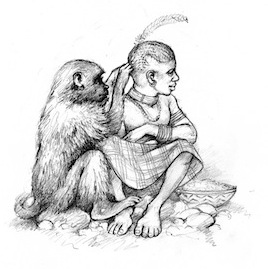
The first man in the world was very poor. He had nothing to eat.
"I will grow food for myself," he said.
He planted pumpkins and corn for his food.
Near the man's field was a troop of baboons. They watched the man. They wanted to eat his food. Every day, they waited. When the man left his field and went away, the baboons came and ate the man's food.
One day, the man saw the baboons in his field. They were eating his ripe pumpkins. He ran after them.
"Go away!" he shouted. "Don't steal my food! Leave my field alone!"
The baboons ran away. But one little baboon child could not run fast. She stayed in the field.
The man picked her up. The little baboon put her arms round his neck. He liked her.
"You can stay with me," he said.
The man took the baboon child to his hut. He looked after her. He gave her food to eat and water to drink.
One day, when the baboon child was big enough, the man took her to the field with him. He began to sow his seed in the earth. The baboon child followed him. She picked up the seeds, and ate them. The man sat down beside the baboon child. She climbed onto his knees.
"No," the man said gently. "Don't pick up the seeds. Don't eat them. Leave them in the earth. They will grow and we will have food to eat. The plants will make new seeds too. We can sow them in the earth next year."
The baboon child understood the man's words. She stopped picking up the seeds and eating them.
"Watch me," the man said to her. "Put the seeds in the earth, like this."
The baboon child watched him. She took seeds from his hands, and put them in the earth.
The plants grew. The baboon child helped the man. She weeded the field and brought in the harvest with him.
When the baboon child grew up, the man married her. Soon, she had a son. He walked on two legs. He was a man like his father. Then the baboon child had a daughter. She walked on two legs, and she was a woman. The son and daughter helped their parents. They worked in the field. The family could grow more food now.
When the son and the daughter grew up, they married each other. They had children, and grandchildren, and great grandchildren. They planted more fields, and moved to many new places.
They forgot their mother, the baboon, and they lived as men and women. They were people. They were our ancestors.
Exercises
A. How much did you understand?
In this story the first man in the world wanted to grow food for himself.
Put sentences 1, 2 and 3 in the right order.
- One day, the man saw the baboons in his field.
- He planted pumpkins and corn for his food.
- "Go away!" he shouted, "Don't steal my food! Leave my field alone!"
The man took the baboon child to his hut. He showed her how to plant seeds. He told her three things.
Put sentences 4, 5 and 6 in the right order.
- "Watch me," the man said to her. "Put the seeds in the earth, like this."
- “They will grow and we will have food to eat.”
- "Don't pick up the seeds. Don't eat them.”
The man and the baboon child married and their children lived as men and women.
Put sentences 7, 8 and 9 in the right order.
- They planted more fields, and moved to many new places.
- The baboon child helped the man. She weeded the field and brought in the harvest with him.
- They worked in the field. The family could grow more food now.
B. When...
Now complete these sentences 1, 2, and 3 with the best endings a, b and c.
- When the man left his field and went away, ......
- One day, when the baboon child was big enough, ......
- When the son and the daughter grew up......
- ……they married each other.
- ……the baboons came and ate the man's food.
- ……the man took her to the field with him.
C. Who was watching?
In the story animals and the man watch each other.
- Who were the baboons watching?
- Who was the man watching?
- Who was the baboon child watching?
D. Now you tell a part of the story...
There are two important characters in the story - the first man and the baboon child. Retell the story. You can choose to be either the man or the baboon child.
If you choose to be the first man you can start your story like this:
I am the first man in the world. I plant food for myself.
If you choose to be the baboon child you can start your story like this:
I am the baboon child. One day I went with other baboons to the first man’s field.
Teachers’ answer key
A. How much did you understand?
The right order of the sentences is 2, 1, 3
He planted pumpkins and corn for his food.
“Go away!” he shouted, "Don't steal my food! Leave my field alone!"
One day, the man saw the baboons in his field.
The right order of the sentences is 6, 5, 4
"Don't pick up the seeds. Don't eat them.”
“They will grow and we will have food to eat.”
"Watch me," the man said to her. "Put the seeds in the earth, like this."
The right order of the sentences is 8, 9, 7
The baboon child helped the man. She weeded the field and brought in the harvest with him.
They worked in the field. The family could grow more food now.
They planted more fields, and moved to many new places.
B. When...
- 1/b. When the man left his field and went away, the baboons came and ate the man's food.
- 2/c. One day when the baboon child was big enough, the man took her to the field with him.
- 3/a. When the son and the daughter grew up, they married each other.
C. Who was watching?
- Who were the baboons watching?
They were watching the man. - Who was the man watching?
He was watching the baboon child. - Who was the baboon child watching?
She was watching the man.
For teachers — answers to the exercises above.